
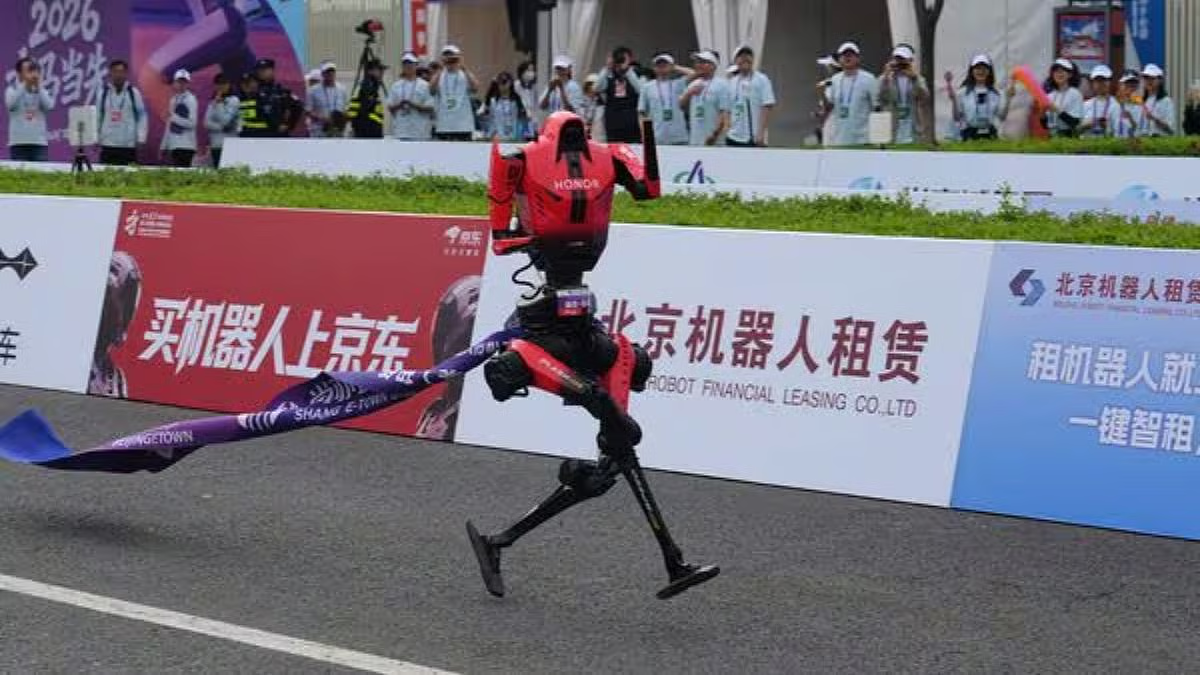
Robots have spent years trailing humans in endurance sport. In Beijing this weekend, they moved decisively into the lead.
A humanoid robot built by Chinese smartphone maker Honor completed the Beijing E-Town Half Marathon in 50 minutes and 26 seconds, beating the human half-marathon world record of 57 minutes and 20 seconds set recently by Jacob Kiplimo.
That gap matters. In elite sport, shaving even a few seconds from a world-class time can define a career. This machine finished more than seven minutes ahead of the fastest human performance ever recorded over the same distance.
The result marks a dramatic leap from last year’s inaugural event, when the quickest robot took more than two hours and 40 minutes to cross the finish line. The pace of progress mirrors what businesses often see with emerging technologies: years of modest gains, followed by a sudden jump that changes expectations overnight.
Beijing’s race featured more than 100 robot teams running alongside roughly 12,000 human participants. Organisers separated the machines onto a parallel course to avoid collisions, though that did not stop a handful of chaotic moments. Some robots tripped immediately after the start, others crashed into barriers, and several collapsed before the finish. Engineers followed in golf carts, ready to retrieve fallen machines or restart systems mid-race.
Nearly half the competing robots navigated the course autonomously, without remote control. That detail may prove more important than the headline-grabbing finish time. A fast robot is impressive. A robot that can make decisions independently over 21 kilometres of turns, inclines and changing terrain points to something far more commercially valuable.
Factories, warehouses, logistics centres and hazardous industrial sites all rely on movement, balance and adaptability. A machine capable of maintaining speed and stability for nearly an hour under race conditions could eventually move into jobs where human fatigue, injury risk or repetitive strain create costly limitations.
Honor’s robots dominated the podium by combining lightweight frames, advanced cooling systems and leg designs that closely mirror human anatomy. Engineers reportedly borrowed liquid cooling techniques from smartphone hardware, a reminder that breakthroughs often come from combining expertise across industries rather than inventing entirely new technology from scratch.
China’s broader strategy also sits behind the spectacle. The country has pushed aggressively into humanoid robotics through government support, public competitions and heavy investment. Events like the Beijing half marathon serve as both engineering test beds and marketing exercises, allowing companies to demonstrate progress in front of investors, officials and global competitors.
The race raised a larger question that extends well beyond sport: what happens when robots no longer just imitate human performance, but exceed it?
Running may seem symbolic, but endurance, coordination and autonomous decision-making form the foundation of many jobs. If robots can already outperform elite athletes in controlled environments, industries that depend on repetitive physical labour may face pressure far sooner than many executives expect.
The machines are not flawless. They still fall, misjudge corners and require human intervention. Yet that is often how technological shifts begin. Early smartphones crashed. Early electric vehicles struggled with range. Early artificial intelligence tools made glaring mistakes. Then the technology improved, rapidly and repeatedly, until the old limitations stopped mattering.
Beijing’s robot half marathon may look like a novelty today. History suggests it could look very different in hindsight.
Author: George Nathan Dulnuan