
Published: April 19, 2026
Category: Technology / Laptops / Reviews
The Asus Zenbook A16 enters a crowded market where “AI laptop” has become more marketing buzzword than meaningful feature. But unlike many competitors, this device makes a serious case for what an AI-focused laptop should actually be.
At its core is the Qualcomm Snapdragon X2 Elite Extreme processor, paired with a powerful neural processing unit capable of 80 trillion operations per second. That translates into industry-leading on-device AI performance well ahead of rivals in benchmarks like Geekbench AI. For users genuinely interested in AI workflows, that’s not just impressive it’s defining.
But here’s the reality: most people still don’t buy laptops for AI. And this is where the Zenbook A16 smartly avoids becoming a niche product.
Performance Beyond the AI Hype
In standard computing tasks, the Zenbook A16 holds its own against top-tier devices like the Apple MacBook Pro 14 (M5). Its 18-core CPU delivers strong multicore performance, making it suitable for productivity, multitasking, and creative work.
However, there’s a clear trade-off. The integrated Qualcomm Adreno X2-90 graphics fall short in gaming and 3D workloads. If gaming is a priority, alternatives with stronger GPUs especially Intel’s Arc graphics are a better bet.
Design: Lightweight Without Compromise
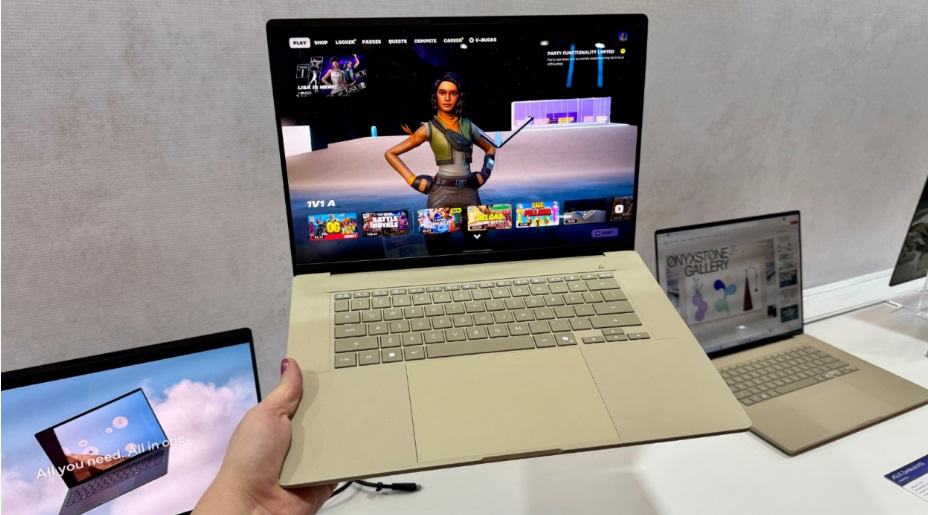
One of the standout features is the laptop’s build. Thanks to Asus’s “Ceraluminum” material, the Zenbook A16 weighs under 3 pounds remarkably light for a 16-inch device. It manages to feel both sturdy and portable, something many large laptops struggle to balance.
The 16-inch OLED display is another highlight. With a 3K resolution, 120Hz refresh rate, and excellent brightness for an OLED panel, it delivers vibrant colors and sharp visuals. Whether you’re working, streaming, or editing content, the screen is a major selling point.
Battery Life and Practical Use
Battery life lands at around 14.5 hours in testing. That’s solid for a large OLED laptop, though it falls short of the exceptional endurance seen in smaller or Apple silicon-based devices.
There are also a few practical compromises:
- Limited upgradeability (soldered RAM, single SSD slot)
- App compatibility concerns due to the ARM-based architecture
- A mechanical touchpad instead of a premium haptic one
These aren’t dealbreakers, but they’re worth considering especially at the $1,700 price point.
Who Is It For?
The Zenbook A16 sits in an interesting position. It’s ideal for:
- Users interested in AI-powered workflows
- Professionals who want a large, high-quality display in a lightweight form
- Everyday users who value performance, battery life, and portability
It’s less suited for:
- Gamers
- Users reliant on niche Windows apps not optimized for ARM
Final Verdict
The Asus Zenbook A16 proves that an AI laptop can be more than just branding. It delivers genuinely powerful AI performance while still excelling as an everyday machine.
Even if you don’t care about AI today, this is a laptop built with the near future in mind where those capabilities may become far more relevant.
Author. Adigun Adedoye.