
Category: Technology / AI / Markets
Published: April 13, 2026
Alphabet’s Google is making a significant shift in its quantum computing strategy and investors are paying close attention.
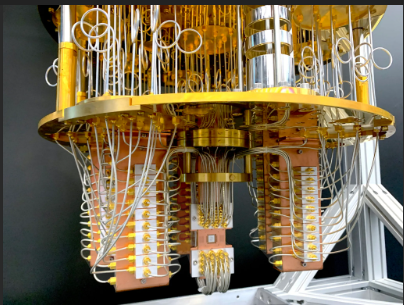
For years, Google has been a leader in superconducting quantum technology, the same approach pursued by IBM. In late 2024, the company unveiled its “Willow” quantum device, a major milestone that helped cement its position in the race toward practical quantum computing.
But now, Google is expanding beyond that foundation.
The company has launched a new quantum hardware initiative in Colorado focused on neutral atom technology, a different and less mature approach that could offer long-term advantages in scalability and efficiency. The project will involve collaboration with leading researchers at the Joint Institute for Laboratory Astrophysics (JILA), alongside the hiring of quantum physicist Adam Kaufman to lead development.
This move signals that Google may be hedging its bets.
Neutral atom systems work by trapping individual atoms using lasers, allowing them to function as qubits. Unlike superconducting systems, which require extremely cold environments, neutral atom approaches may reduce energy demands and simplify infrastructure, making them attractive for large-scale deployment.
Analysts say the potential upside is significant.
Because atoms are naturally identical, neutral atom systems could offer improved consistency and easier scaling. They also allow for flexible qubit positioning and connectivity, which may enhance error correction, one of the biggest challenges in quantum computing today.
Still, the technology remains in early stages compared to superconducting systems.
Google’s continued investment in both approaches suggests a dual-track strategy aimed at maintaining leadership regardless of which technology ultimately proves dominant.
The company has also strengthened its position through partnerships and investments, including backing neutral atom startup QuEra alongside Nvidia and SoftBank. At the same time, Google continues to build on its superconducting expertise through acquisitions like Atlantic Quantum.
Despite the progress, uncertainty remains.
Google has yet to provide a detailed public roadmap for its quantum ambitions, making it difficult for investors to assess timelines and milestones. Meanwhile, the broader quantum computing sector has struggled in 2026, with several pure-play stocks experiencing significant declines.
Even so, Google’s long-term goal remains unchanged: building a fault-tolerant, commercially viable quantum computer by the end of the decade.
If successful, the impact could be transformative, not just for computing, but for industries ranging from pharmaceuticals to artificial intelligence.
Author.Adigun Adedoye