
Published: April 2026
Category: Tech / Business / AI
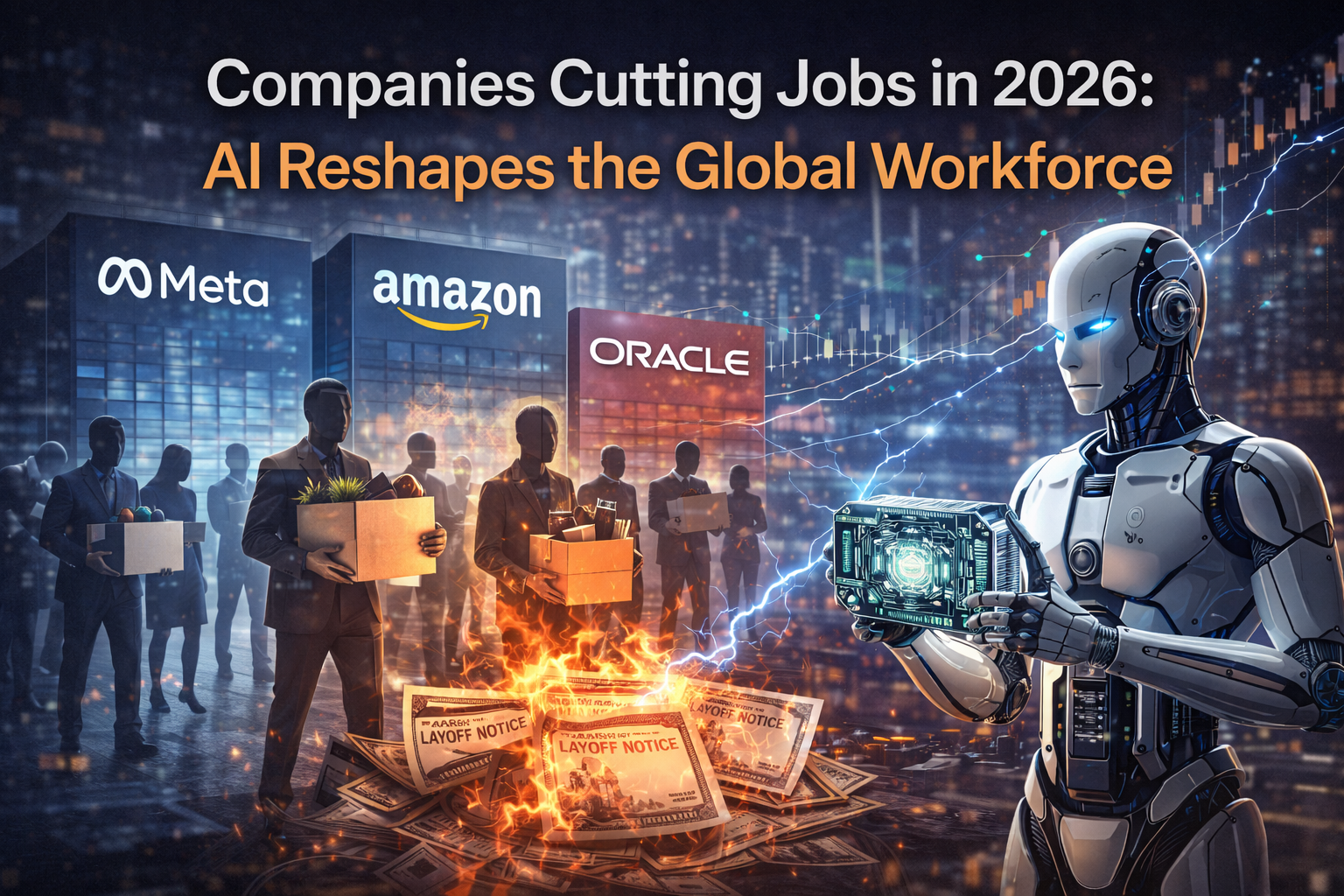
The wave of layoffs sweeping across 2026 is no longer just about cost-cutting—it’s about transformation. Major global companies, including Meta Platforms, Amazon, and Oracle, are restructuring their workforces as artificial intelligence rapidly reshapes how businesses operate.
AI Driving Workforce Changes
Artificial intelligence has become a central factor behind many of these layoffs. Companies are increasingly automating tasks, streamlining operations, and prioritising AI-focused talent.
A report from the World Economic Forum suggests that around 41% of companies expect to reduce their workforce within the next five years due to AI. At the same time, roles in AI, fintech, and data-related fields are expected to grow significantly by 2030.
Major Companies Making Cuts
Several industry leaders have already announced significant job reductions:
- Amazon is cutting around 16,000 corporate roles as part of internal restructuring.
- Meta Platforms has laid off employees across multiple divisions while increasing investment in AI infrastructure.
- Dell Technologies reduced its workforce by roughly 10% for the third consecutive year.
- eBay plans to eliminate about 800 jobs globally.
- Atlassian is cutting around 1,600 roles as it shifts focus toward AI-driven operations.
Other companies such as Nike, Pinterest, and Workday are also restructuring, often citing efficiency improvements and evolving business priorities.
Not All Layoffs Are AI-Driven
While AI is a major factor, not every company is cutting jobs because of it. For example, Epic Games stated its layoffs were linked to declining engagement rather than automation.
Similarly, retailers like Target Corporation are reallocating resources to improve in-store experiences rather than purely adopting AI solutions.
A Broader Economic Shift
The layoffs reflect a wider transformation across industries including tech, retail, finance, and logistics. Companies are balancing rising costs, economic uncertainty, and the need to remain competitive in an AI-driven world.
Some organisations are also using layoffs to simplify structures, reduce bureaucracy, and move faster in decision-making—something especially evident in large tech firms.
The Bigger Picture
Despite the job cuts, the long-term outlook isn’t entirely negative. While some roles are disappearing, new ones are emerging. AI is not just replacing jobs—it is redefining them.
Workers with skills in artificial intelligence, data analysis, and advanced technologies are becoming increasingly valuable as companies rebuild around these capabilities.
Conclusion
The layoffs of 2026 highlight a critical turning point. Artificial intelligence is no longer a future trend—it is actively reshaping the global workforce today.
For businesses, the challenge is adapting quickly. For workers, the priority is evolving skills to stay relevant in an AI-first economy.
Author.Adigun Adedoye.