
Published: January 2026
Category: Technology, Research, Cybersecurity and Automation
A new report from Juniper Research highlights the technologies expected to define the next phase of the Internet of Things and wider digital infrastructure in 2026. The findings suggest the industry is moving beyond experimentation, with organisations now being forced to make real deployment and investment decisions.
According to the report, 2026 marks a turning point where emerging technologies must prove they can scale securely and reliably. Businesses are increasingly focused on resilience, long term planning, and managing complexity rather than chasing rapid innovation alone.
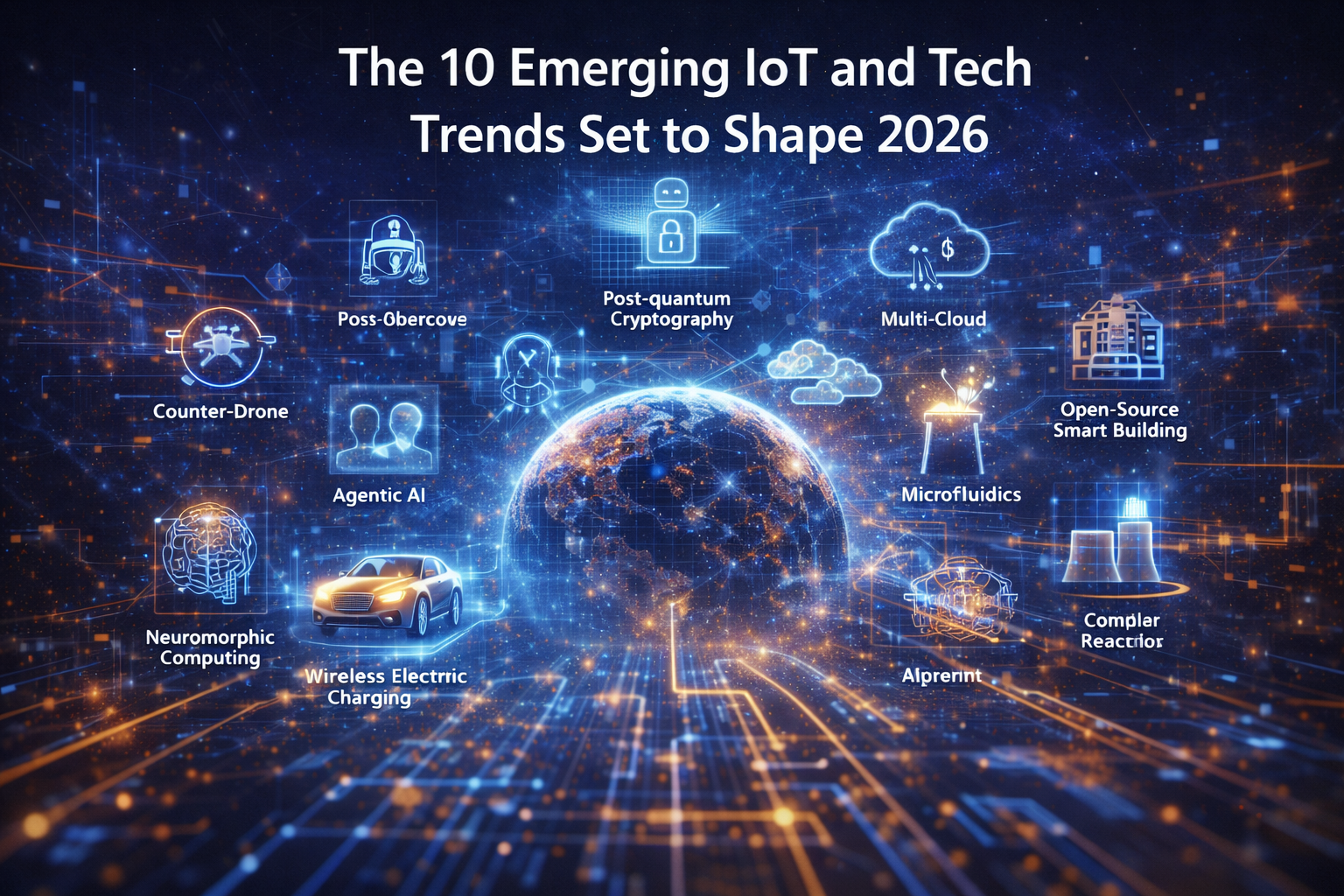
One of the most significant shifts is the growing importance of post quantum cryptography. As future computing threats edge closer to reality, organisations deploying IoT systems are being urged to prepare for new security standards. Hybrid encryption models are expected to play a key role in protecting devices and data during the transition.
Advances in computing architecture are also gaining momentum. Neuromorphic computing is moving closer to commercial deployment, with specialised chipsets designed to overcome current AI performance limits. At the same time, physical AI and humanoid robotics are advancing rapidly, with improvements in autonomy and dexterity opening new opportunities in logistics, manufacturing, and industrial operations.
The report also points to wider adoption of multi agent AI systems, where businesses deploy specialised agents to automate specific tasks. This approach is expected to improve efficiency while reducing the risks associated with relying on single, general purpose AI models.
Infrastructure and energy trends feature heavily. Wireless electric vehicle charging is forecast to expand more quickly, helping remove barriers to EV adoption. Data centres are also under pressure as AI workloads grow, driving interest in microfluidics as a next generation cooling solution.
Security and resilience remain central themes. Investment in counter drone technology is expected to rise as global risks increase, while multi cloud strategies are gaining traction following recent outages that highlighted the dangers of single provider dependency. Rather than full production multi cloud systems, many organisations are expected to prioritise resilience across critical network services.
Energy planning is also evolving, with small modular reactors potentially influencing long term strategies for connected industries. Meanwhile, open source smart building platforms are gaining attention as building owners look to improve efficiency while avoiding vendor lock in.
Overall, the report paints a picture of a maturing technology landscape. For organisations deploying IoT in critical environments, the challenge in 2026 will be adopting advanced technologies at speed without increasing risk, complexity, or operational fragility.
Author.Adigun Adedoye