
Published: April 8, 2026
Category: Technology / Privacy
Across the United States, a growing number of cities are turning their backs on one of the fastest-expanding surveillance technologies in the country. What began as a tool marketed to reduce crime is now at the center of a national debate over privacy, data control and the limits of artificial intelligence in public spaces.
At the heart of the controversy is Flock Safety, a company known for deploying AI-powered license plate recognition cameras and, more recently, advanced surveillance drones. While its technology promises safer neighborhoods, critics argue it is quietly laying the groundwork for something far more intrusive.
A Growing Rejection
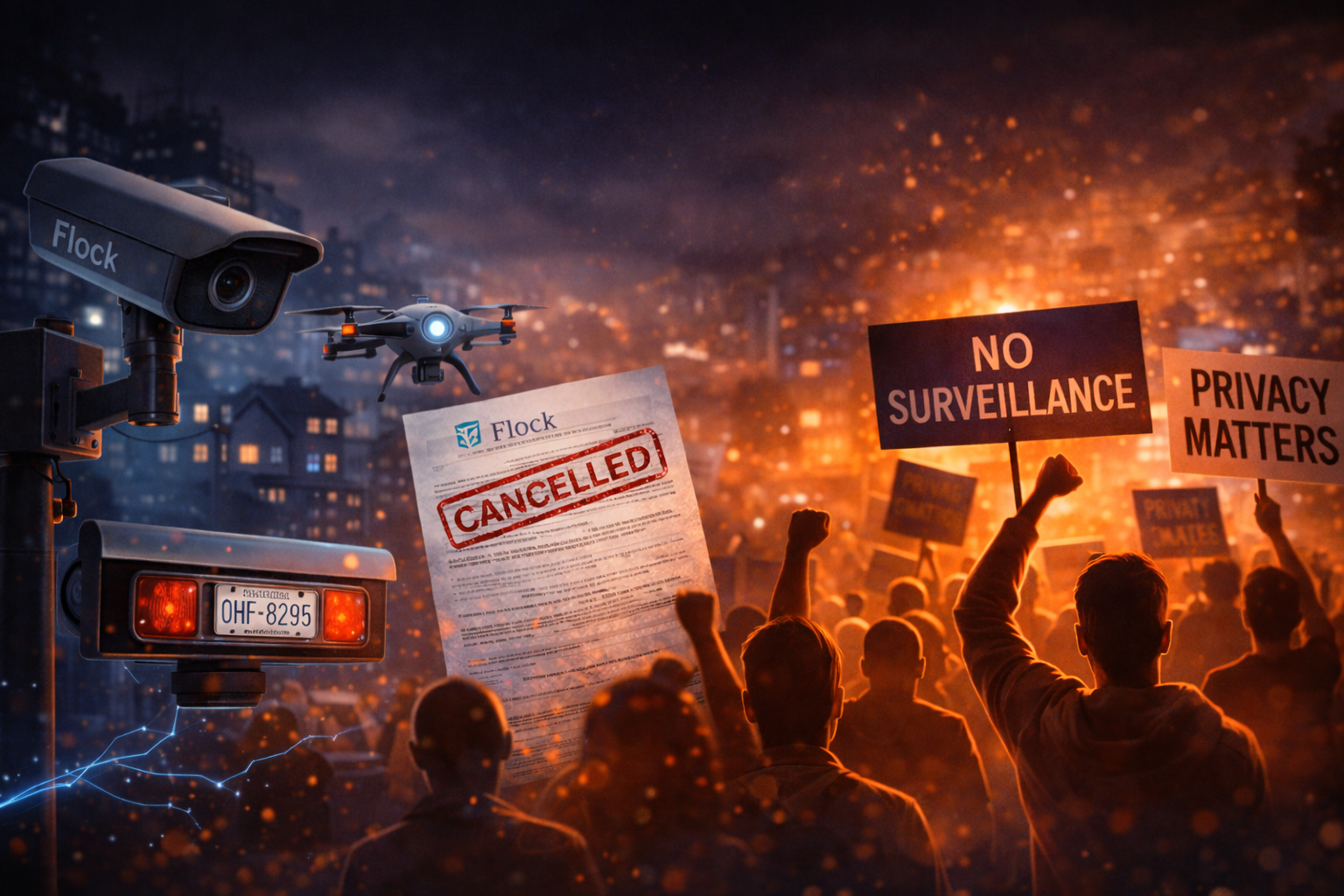
The shift against Flock is no longer isolated. Cities like Bend, Oregon, have already canceled contracts following public pressure, and they are far from alone. Since the start of 2026, dozens of municipalities have suspended or ended agreements with the company, citing concerns about privacy protections and lack of transparency.
For many residents, the issue isn’t just the presence of cameras—it’s the scale. These systems are often installed quietly, meaning communities may not even realize they are being monitored until after the fact.
More Than Just License Plates
Flock’s core product revolves around automated license plate readers (ALPRs), designed to capture images of passing vehicles. But the technology goes far beyond simply scanning plates.
Using machine learning, the system can identify vehicle details such as make, model, color and distinguishing features like roof racks or decals. Law enforcement agencies can then use search tools to reconstruct where a vehicle has been, effectively building a timeline of movement.
More recently, Flock has expanded into drone surveillance through its “Drone as First Responder” program autonomous drones capable of responding to incidents, tracking suspects and providing live aerial footage.
While the company maintains that it does not use facial recognition, its tools can still be used to identify individuals indirectly through vehicle data and descriptive searches, raising concerns about how far the technology can go.
The Privacy Debate Intensifies
Flock insists that license plate data is not personal information. However, privacy advocates strongly disagree, pointing out that vehicle data is legally tied to individual owners.
Organizations like the American Civil Liberties Union warn that the ability to search for vehicles using descriptive prompts—such as color or unique features—creates a powerful tracking system that can extend beyond cars to people themselves.
The concern deepens with data handling. While Flock says it stores information securely and deletes it after a set period, the data is ultimately controlled by its customers—local law enforcement agencies and private entities. This decentralization means oversight varies widely, and accountability can be inconsistent.
Misuse and Real-World Consequences
Reports of abuse have only intensified public concern. In multiple cases, law enforcement officials have been accused of misusing the system for personal reasons, including tracking individuals without proper justification.
Although Flock provides audit logs to monitor usage, critics argue these safeguards are not enough. Officers can still conduct broad or vague searches, making it difficult to detect misuse in real time.
These incidents have fueled fears that such technology, if left unchecked, could enable widespread surveillance with minimal accountability.
Data Sharing and Federal Concerns
Another major flashpoint is how surveillance data is shared. While Flock states it does not directly partner with federal agencies, local law enforcement can and often does share data with organizations like Immigration and Customs Enforcement.
This indirect access has raised alarms, particularly as reports show departments using the system for immigration-related searches. With nationwide data-sharing tools now in place, information collected in one city can potentially be accessed across the country.
Laws Struggle to Keep Up
In response, lawmakers are beginning to act. New legislation across several states aims to limit how long surveillance data can be stored and restrict how it can be shared.
Some states are pushing for strict data deletion timelines, while others are introducing laws to prevent information from being shared outside state lines without proper authorization. However, enforcement remains uneven, and violations have already been reported.
A Much Bigger Trend
Even as cities reject Flock, the broader issue isn’t going away. Other companies, including Motorola Solutions and Palantir Technologies, are developing similar AI-driven surveillance tools.
This raises a critical question: if one company is removed, will another simply take its place?
The Bottom Line
The backlash against Flock Safety reflects a larger shift in public sentiment. Communities are no longer passively accepting surveillance in exchange for security they are demanding transparency, accountability and limits.
As AI-powered monitoring becomes more advanced and widespread, cities are being forced to decide where to draw the line. The outcome of this debate will likely shape not just local policies, but the future of surveillance itself.
Author.Adigun Adedoye.