
Published: April 8, 2026
Category: AI / Technology / Semiconductors
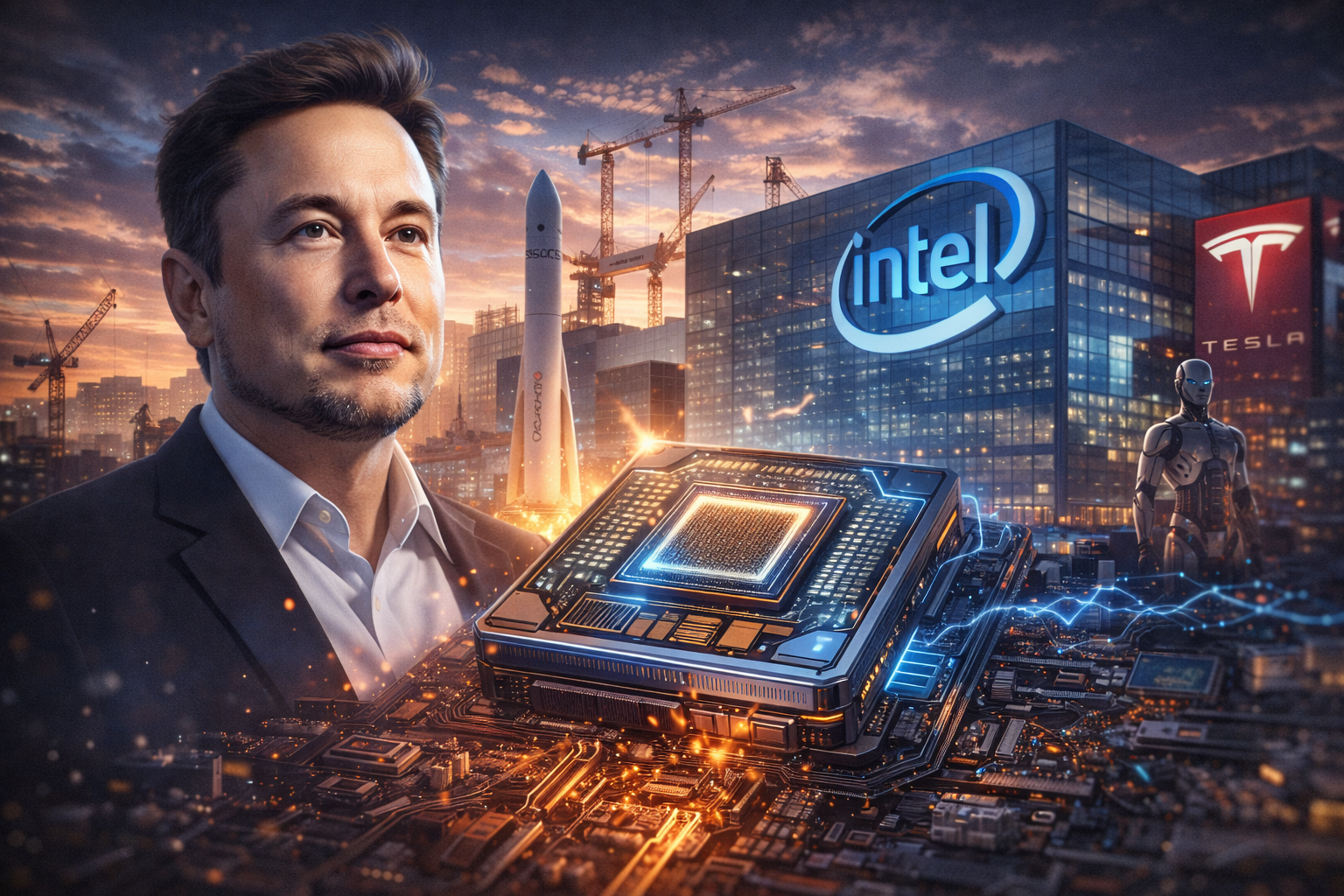
Elon Musk’s ambitious $25 billion Terafab project has secured a major partnership with Intel, marking a significant step forward in the race to dominate artificial intelligence hardware production. The collaboration will see Intel help design and build advanced chip manufacturing systems for the Texas-based facility backed by Tesla, SpaceX, and xAI.
The Terafab project aims to produce next-generation semiconductors that will power a wide range of future technologies, including self-driving vehicles, humanoid robots, and large-scale AI data centers. As demand for computing power continues to surge, projects like Terafab highlight a growing push by US companies to bring chip production closer to home.
Historically, much of the world’s advanced chip manufacturing has been handled by Taiwan Semiconductor Manufacturing Company, which produces the majority of cutting-edge semiconductors globally. However, the rapid expansion of AI is forcing companies to rethink supply chains and invest heavily in domestic production capabilities.
Intel’s involvement is expected to accelerate Terafab’s development. CEO Lip-Bu Tan described the partnership as a necessary evolution in semiconductor manufacturing, emphasizing that the project represents a major shift in how chips will be designed and produced in the future.
The facility is expected to eventually generate enough output to deliver one terawatt of computing power annually, aligning with Musk’s broader vision of scaling AI infrastructure to unprecedented levels.
Despite the optimism, challenges remain. Intel itself has faced delays in its own fabrication projects, including its Ohio-based facilities, which have been pushed back by several years despite significant investment. This raises questions about timelines and execution for Terafab as well.
Additionally, Musk’s history of ambitious announcements some of which have faced delays or failed to materialize means industry observers are cautiously watching how the project unfolds.
Still, the partnership between one of the world’s largest chipmakers and Musk’s ecosystem of companies signals a clear direction for the future: a massive expansion of AI-driven hardware, built closer to home, and designed to support the next generation of intelligent systems.
Author.Adigun Adedoye.