
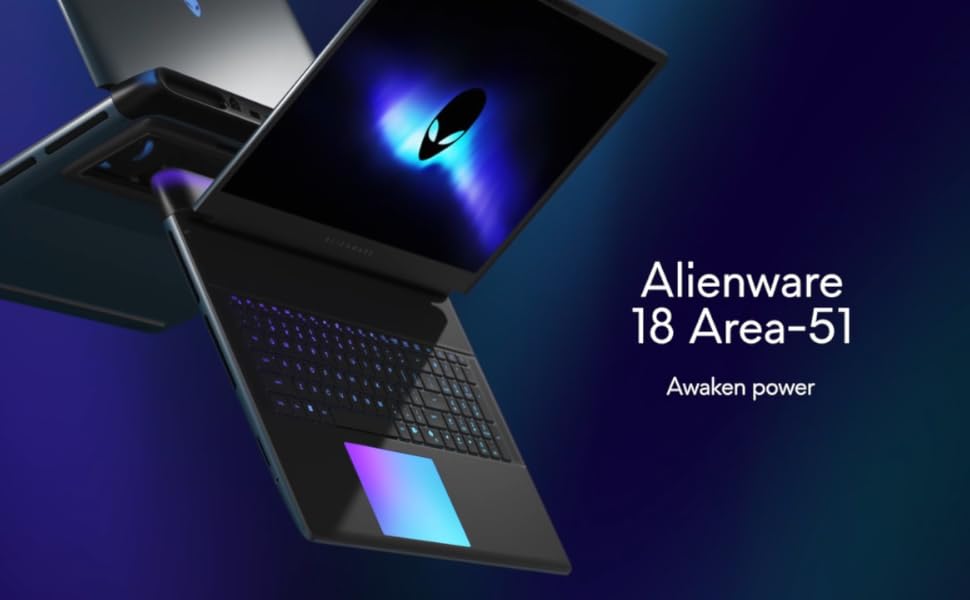
The company has refreshed its flagship Alienware gaming laptops, introducing a new wave of machines powered by Intel’s latest Arrow Lake-HX Refresh processors. The move targets users who demand more from their hardware, whether they are pushing frame rates in competitive gaming or running resource-heavy creative workloads.
At its core, this update isn’t about reinvention. It’s about refinement—taking already powerful systems and pushing them further where it counts.
A calculated performance upgrade
Dell has rolled out updates across three key models:
- Alienware 18 Area-51
- Alienware 16 Area-51
- Alienware 16X Aurora
Each now integrates Intel’s refreshed Core Ultra HX-series chips, including high-end options such as the Core Ultra 9 290HX Plus. These processors bring more cores and higher boost speeds, equipping laptops to handle intensive multitasking without compromise.
The strategy resembles a business scaling decision: rather than launching entirely new products, Dell enhances proven platforms with stronger internals. It’s the same logic leaders apply when upgrading a high-performing team instead of restructuring it.
Graphics performance follows the same trajectory. The range now stretches up to Nvidia’s GeForce RTX 5090 in the top-tier models, while the Alienware 16X Aurora receives a notable step up to the RTX 5070 Ti.
What does that mean in practical terms? Faster rendering, smoother gameplay, and the ability to future-proof against increasingly demanding titles.
Displays that shift the experience
The most visible transformation sits in the 16-inch models.
Dell has introduced anti-glare OLED panels—an upgrade that dramatically improves contrast, colour accuracy, and responsiveness. Response times drop to as low as 0.2 milliseconds, while brightness climbs to around 620 nits.
That change goes beyond visual appeal. It reshapes how users interact with their machines. Whether editing video, designing assets, or gaming competitively, clarity and speed translate directly into performance.
Consider the parallel in everyday work: switching from a standard monitor to a high-end display often reveals inefficiencies you didn’t realise existed. The same principle applies here—better hardware sharpens both output and decision-making.
Power without compromise—almost
The larger Alienware 18 Area-51 continues to anchor the lineup as a performance-first machine. It pairs high-refresh-rate displays with top-tier GPUs and expansive memory configurations, reaching up to 64GB of DDR5 RAM and substantial SSD storage options.
Yet Dell hasn’t chased uniformity across the range. The 18-inch model retains its LCD panel, while the OLED upgrade remains exclusive to the 16-inch variants. That decision raises a practical question: does raw size still outweigh display quality for high-end users?
Battery capacity across models sits around 96Wh, paired with Wi-Fi 7 and modern connectivity standards. These are not devices built for mobility first—they are engineered for sustained performance, with portability as a secondary benefit.
Incremental change, strategic intent
Dell’s approach reflects a broader industry pattern. Instead of chasing dramatic redesigns, manufacturers are tightening the gap between desktop-level power and mobile convenience.
The enhancements follow three clear priorities:
- More processing power through updated CPUs
- Stronger graphics capabilities across tiers
- Noticeable display improvements where user impact is highest
Each decision aligns with how users actually upgrade technology in their own lives. Few replace everything at once. Most look for targeted gains—speed, clarity, reliability.
The bigger question
These updates raise a sharper point about the direction of high-performance laptops.
If incremental upgrades continue to deliver meaningful gains, do users still need entirely new product categories? Or will the future belong to iterative refinement—devices that evolve year by year without radical redesign?
Dell’s latest Alienware refresh suggests the latter. It bets on consistency, performance, and calculated improvements rather than spectacle.
For gamers and power users, the message is clear: the ceiling keeps rising. The only question is how much headroom you need.
Author: George Nathan Dulnuan