
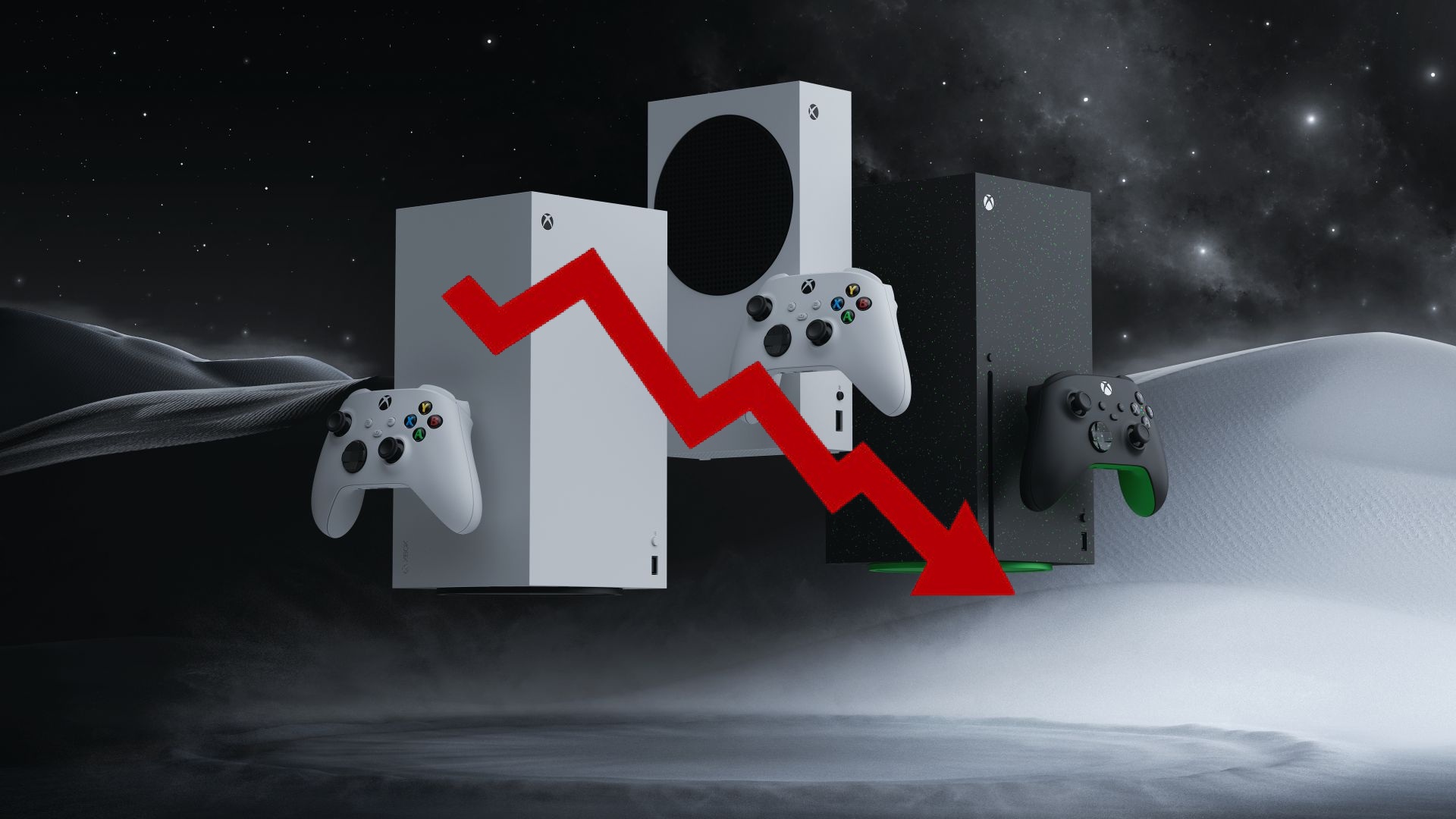
📉 Hardware Sales & Market Positioning
Estimates for Xbox Series X and Series S sales in 2025 suggest approximately 1.7 million units sold year-to-date, placing Microsoft’s hardware significantly behind its competitors. By contrast, Nintendo’s Switch 2 has emerged as a dominant performer, with tens of millions of units shipped globally since its June launch, while PlayStation 5 sales remain comfortably ahead of Xbox in total units for the year.
Independent tracker data also indicates that in the US console market in November, Xbox hardware experienced the steepest year-on-year decline (around 70%), while PS5 and Switch platforms proved comparatively more resilient. These trends are unfolding against a wider industry slowdown: total video game hardware sales in the US fell to a 20-year low in late 2025, with both unit sales and consumer spending down markedly.
🧠 Technical & Strategic Shifts at Microsoft
Rather than reinforcing a traditional console-led battle for hardware market share, Microsoft’s Xbox division has been undergoing a strategic repositioning.
Internal restructuring has resulted in job losses, studio closures, and the cancellation of several high-profile projects. At the same time, Xbox has increasingly embraced a multiplatform strategy, releasing first-party titles on PlayStation, Nintendo Switch 2, PC, and cloud streaming services, rather than restricting them to Xbox hardware.
Microsoft leadership has signalled that hardware dominance is no longer the primary success metric. Instead, the focus has shifted towards maximising reach and engagement through services such as Xbox Game Pass, cloud gaming, cross-platform play, and a unified ecosystem.
For technologists, this represents a broader architectural pivot: the console is now treated as one endpoint within a distributed gaming platform, where cloud compute, cross-platform services, APIs and subscription infrastructure play a central role in long-term strategy.
🌐 Implications for the Console Ecosystem Platform
With Xbox first-party titles appearing on PlayStation and Switch hardware, the traditional model, in which exclusives drive hardware sales, is increasingly being eroded.
Meanwhile, the Switch 2’s hybrid hardware-software approach continues to resonate, reinforcing the idea that innovation in form factor and user experience still carries significant weight. At the same time, software and services revenue — including subscriptions, cloud access and digital distribution, now accounts for a growing share of the industry’s value, in some cases eclipsing raw hardware unit sales as the key performance indicator for developers and publishers.
🧩 What This Means for Developers & Technologists
For those tracking the technical evolution of gaming platforms, Microsoft’s shift offers a clear example of platform-agnostic, services-first design:
Data-driven subscription models: Services such as Game Pass prioritise long-term engagement and retention over upfront hardware sales, reshaping approaches to monetisation, analytics and churn management in game development.
APIs and cross-platform frameworks: Supporting games across heterogeneous environments, from console silicon to cloud infrastructure, demands flexible engine architectures and robust data serialisation strategies.
Cloud streaming and compute scaling: Xbox’s cloud expansion accelerates the adoption of remote execution models, low-latency encoding and decoding pipelines, and seamless cross-device session continuity.
Author: Mohammed Najem