
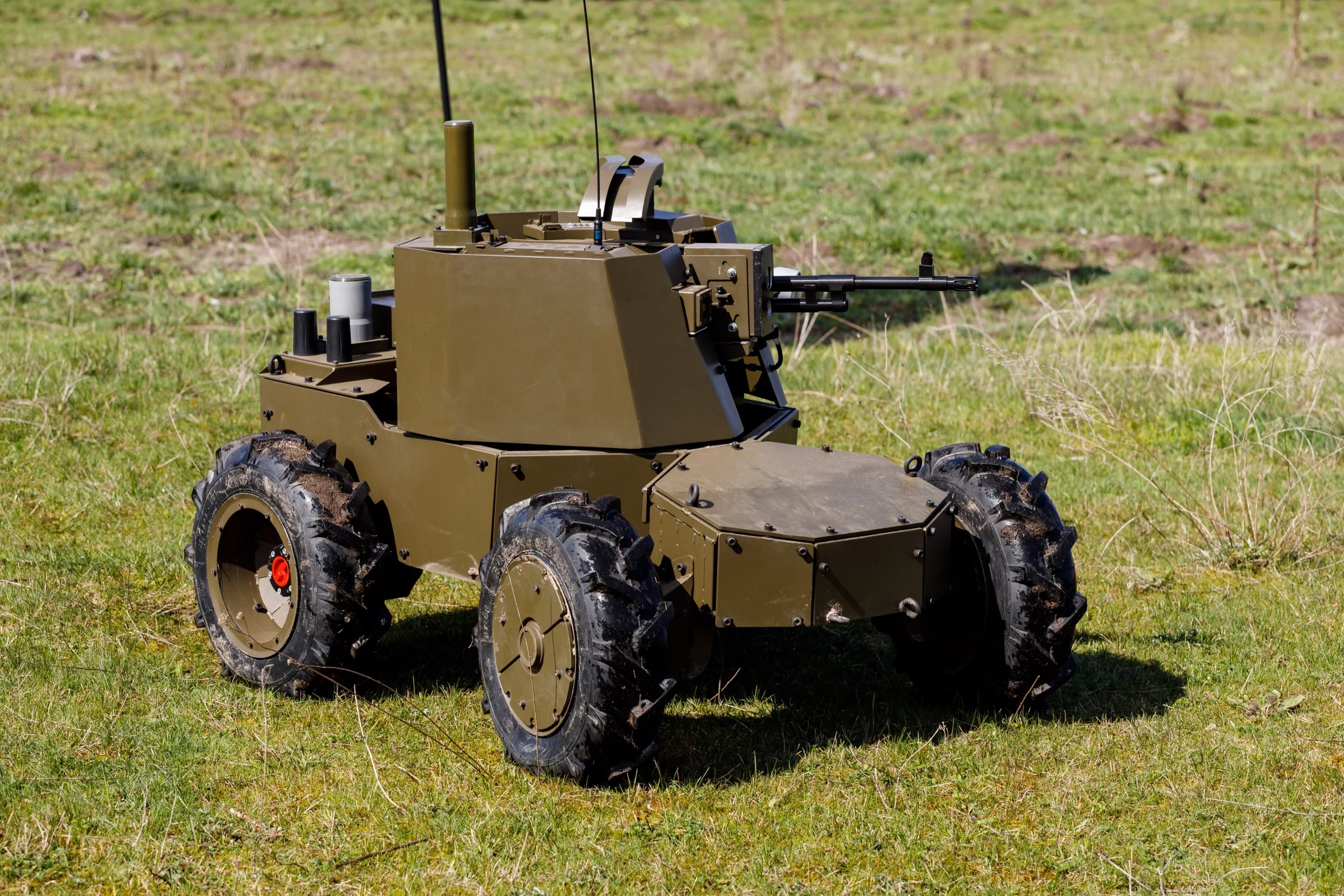
Four years into Russia’s grinding invasion, Ukraine’s battlefield has undergone a quiet but decisive shift. Infantry once led the charge, followed by missiles and drones. Now, a new force is taking centre stage: remote-controlled ground robots, steadily reshaping how war is fought and, crucially, who survives it.
Ukrainian commanders no longer speak about robotic systems as experimental tools. They treat them as frontline assets—machines that can take risks soldiers no longer have to.
President Volodymyr Zelensky pointed to a defining moment. In the Kharkiv region, Ukraine’s 3rd Separate Assault Brigade reclaimed territory using only drones and unmanned ground vehicles. No infantry advanced. No Ukrainian lives were lost.
“The occupiers surrendered, and the operation was carried out without infantry and without losses on our side,” he said.
That single operation signals a broader transformation. War, once dependent on sheer manpower, now pivots towards precision, automation and endurance.
Machines That Take the Risk
Step into the daily reality of a Ukrainian soldier and the appeal becomes obvious. Moving across open ground invites immediate detection from enemy drones. Delivering ammunition or evacuating the wounded can mean certain exposure.
Ground robots change that equation.
These unmanned systems now handle tasks that once demanded human presence:
- Transporting ammunition and supplies across contested terrain
- Evacuating injured soldiers under fire
- Laying or clearing mines
- Holding defensive positions or launching targeted attacks
Commanders frame the logic bluntly: robots can be replaced; soldiers cannot. Some estimate that up to 30 per cent of frontline roles could eventually shift to machines.
The reasoning echoes decisions made in everyday business. When leaders automate repetitive or high-risk processes, they free human talent for judgement-driven work. Ukraine applies that same principle under far harsher stakes—where efficiency directly translates into survival.
A War That Constantly Reinvents Itself
The conflict has never stood still. Drones redefined reconnaissance and strike capabilities early on. Now, ground robots extend that innovation across the battlefield.
Engineers and soldiers operate in a rapid feedback loop. A unit tests a robot under fire, reports flaws, and developers adjust designs within weeks. This cycle mirrors how tech firms refine software updates—except here, iteration happens amid active combat.
What emerges is a military ecosystem built on speed and adaptation. Ukraine has positioned itself as a leader in producing these systems, with a growing industrial base supporting deployment at scale.
The implications stretch beyond Ukraine. If one side proves that relatively low-cost robotic systems can offset a larger opponent’s manpower advantage, how long before other nations follow?
Tactical Advantage Meets Strategic Questions
Ground robots deliver clear advantages:
- Reduced casualties in high-risk operations
- Lower operational costs compared with traditional armoured vehicles
- Increased endurance in hostile environments
- Flexibility across logistics and combat roles
Yet they introduce new uncertainties. Machines depend on communication links that can be disrupted. They struggle in complex terrain. And their increasing autonomy raises ethical questions about how force is applied remotely.
What happens when decision-making moves further away from the battlefield? Does distance make conflict easier to sustain—or harder to control?
These are not abstract concerns. They shape procurement strategies, alliances and the future balance of power.
The Future Has Already Arrived
Ukrainian officials and engineers speak about robotic warfare not as a distant prospect but as a present reality. The battlefield already reflects that shift.
One successful mission without infantry may seem like a milestone. In practice, it signals something larger: a transition from human-led assaults to machine-supported—or even machine-led—operations.
The question is no longer whether robots will define modern warfare. It is how quickly that definition will spread.
If a conflict can be fought, and occasionally won, without soldiers stepping into direct danger, what does that mean for every army still built around human deployment?
Author: George Nathan Dulnuan