
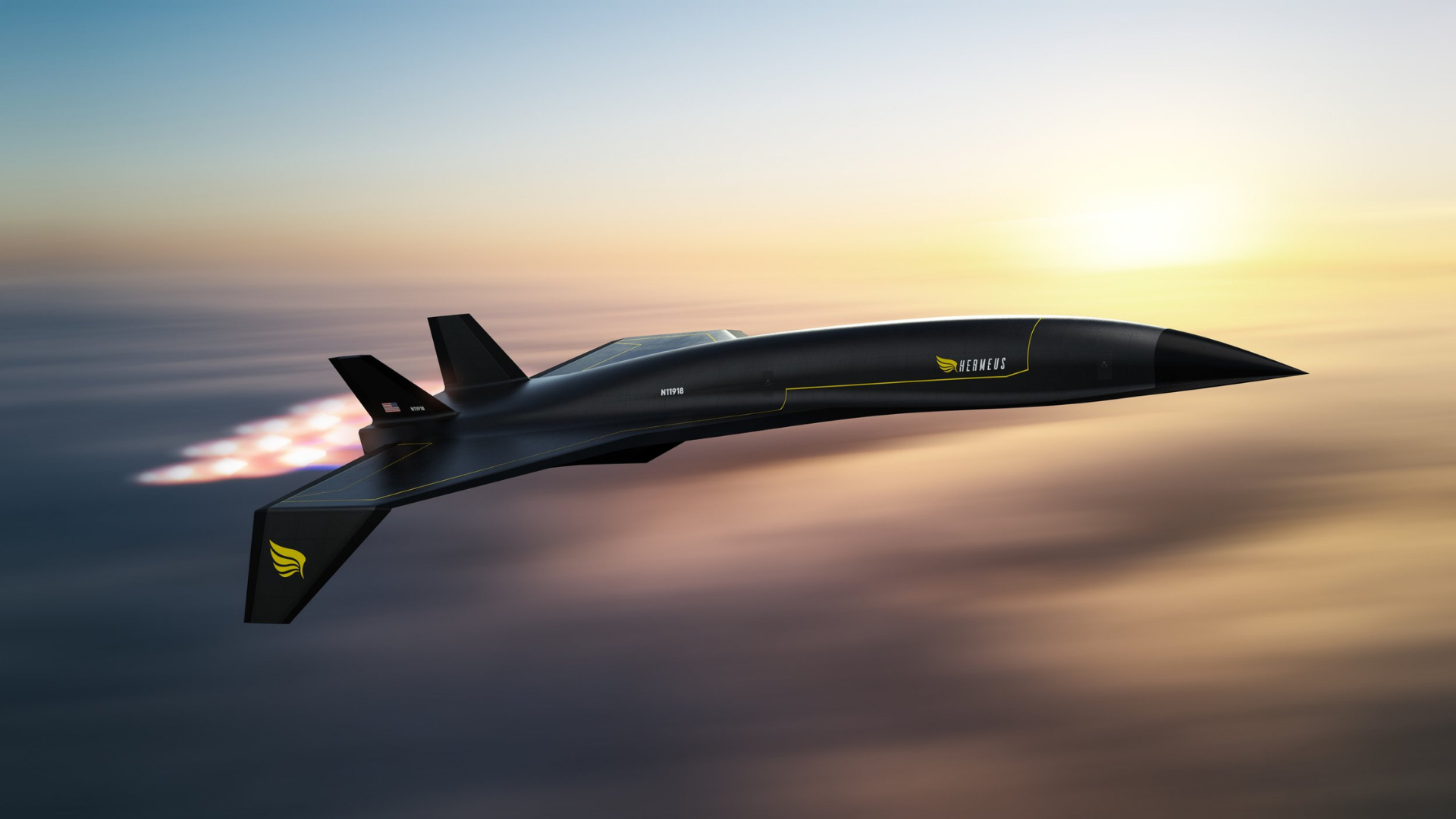
Hermeus has secured $350 million in fresh funding, accelerating its push to develop what it describes as the “fastest unmanned aircraft” — and in the process, joining the growing ranks of billion-dollar defence startups.
The Los Angeles-based company confirmed Tuesday that the raise includes $200 million in equity, led by Khosla Ventures, with continued backing from Canaan Partners, Founders Fund, In-Q-Tel, and RTX Ventures. New investors include Cox Enterprises’ venture arm and Destiny Tech100. An additional $150 million comes through debt financing, a structure Hermeus is using strategically to retain control as it scales.
That balance between growth and ownership reflects a broader reality facing hardware-heavy startups. Building advanced aircraft demands enormous capital, and equity dilution can quickly erode founder influence. Hermeus is choosing a different path — one that leans on debt to preserve its long-term autonomy.
“We build a lot of hardware, we’re expanding our manufacturing capabilities, and if we can finance a large portion of our spend non-dilutively, it’s absolutely the way to do it,” said co-founder and CEO AJ Piplica.
The timing of the raise aligns with a surge in defence technology investment. Venture and corporate capital has poured into the sector, surpassing $9 billion across 265 deals globally last year, according to PitchBook. Corporate investors alone contributed $2 billion across 28 rounds. Governments are rethinking security priorities, and investors are following suit.
Yet Hermeus’ momentum stems from more than favourable market conditions. A pivotal engineering decision reshaped its trajectory. Initially, the company invested heavily in developing its own engine — a costly and complex undertaking. That approach shifted after discussions with RTX Ventures opened a new path.
Instead of building from scratch, Hermeus partnered with Pratt & Whitney, an RTX subsidiary, to adapt the proven F100 engine for hypersonic use. The move traded control for speed — and paid off.
The decision shortened development timelines, enabled faster testing cycles, and helped secure contracts with the U.S. Department of Defense. It also allowed the company to pursue multiple milestones simultaneously rather than betting everything on a single breakthrough.
“This accelerates us to Mach 5, and also reinforces the economics of the business while satisfying near-term demand from the Department of Defense,” said president Zach Shore. “I think in that way, you have a number of concentric circles overlapping simultaneously that reinforce the business, that reinforce the customer, and that, you know, reinforce the technology maturation.”
Hermeus is applying a rapid prototyping model rarely seen in aviation. Last month, it flew a demonstrator aircraft roughly the size of an F-16 fighter jet. The next version aims to reach supersonic speeds, with a third design already in development.
That pace mirrors the iterative philosophy popularised by SpaceX: build quickly, test aggressively, accept failure, and refine. In an industry where new aircraft programmes often stretch across decades, Hermeus is compressing timelines into years.
The challenge lies less in technology than in talent. Aviation has not produced new full-scale aircraft at high frequency for decades, leaving a gap in experienced engineers who have built systems from the ground up.
“There’s nowhere in the world where companies are building new full-scale aircraft on an annual basis, clean sheet or otherwise,” Piplica said. “People used to do that, but they’re all dead, which means you have to go make those people in one way or another.”
The funding will support that effort, expanding a workforce that is nearing 300 employees. Hiring and training engineers capable of executing rapid iteration at scale may prove as critical as any technological breakthrough.
Hermeus has already completed two successful test flights, including an earlier, smaller demonstrator. Still, leadership is clear-eyed about what lies ahead. Failure is not just possible — it is expected.
“The challenge is, how do you pick the right kind of chunks of risk to take on and apply your capital to over time,” Piplica said. “Like, yeah, we could crash an airplane, and I expect it’ll happen at some point in our development program. We’re set up to do that very safely. But this is also why, like, building more aircraft is super important. If you don’t build a lot, it takes you a lot longer, because you’re gonna go baby things. You know, we wonder why it takes us 20, 25, years to develop a new aircraft?”
That philosophy raises a defining question for the defence sector: can speed and iteration replace the slow, risk-averse development cycles that have long defined aerospace? If Hermeus succeeds, it may not just build a hypersonic aircraft — it could reset expectations for how quickly advanced military technology reaches the field.
Author: George Nathan Dulnuan