
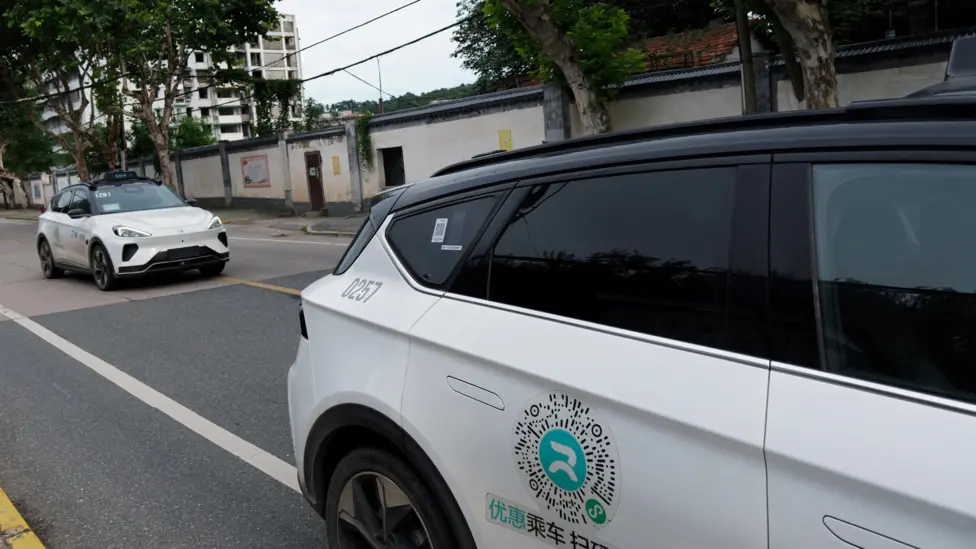
A sudden outage involving robotaxis in Wuhan has reignited concerns about the reliability of autonomous vehicles after at least a hundred cars stopped mid-traffic.
Local police said early findings point to a “system malfunction” that caused multiple vehicles to halt in the middle of the road. While no injuries were reported and passengers exited safely, the incident disrupted traffic and raised fresh questions about how these systems fail.
Videos circulating on social media appear to show the scale of the disruption, including one clip suggesting a highway collision. Authorities have not confirmed any injuries linked to the footage and say investigations are ongoing.
Baidu, the operator behind the Apollo Go robotaxi service, has not yet commented publicly.
Apollo Go runs in dozens of cities, primarily across China, and represents one of the most advanced large-scale deployments of driverless taxis. Its expansion signals growing confidence in autonomous systems—but incidents like this expose the limits of that confidence.
The timing matters. In December 2025, Uber and Lyft announced partnerships with Baidu to test Apollo Go vehicles on UK roads, targeting trials in 2026. Regulators have yet to approve those programmes, and events like the Wuhan outage could influence their decisions.
For policymakers, the question is no longer whether autonomous vehicles can operate under ideal conditions. It is how they behave when systems fail.
Jack Stilgoe, professor of science and technology policy at University College London, framed the issue clearly. Driverless technology, he said, “may be safer on average” than human drivers, but it can “still go wrong in completely new ways”.
He added: “If we’re going to make good choices about this technology, we need to understand entirely new types of risk.”
That distinction matters. Human error follows familiar patterns—fatigue, distraction, misjudgement. Autonomous systems introduce failures that can scale instantly. A single software issue can immobilise hundreds of vehicles at once.
Recent incidents reinforce that pattern:
- In December 2025, a power outage in San Francisco halted Waymo taxis, triggering widespread congestion
- In August 2025, an Apollo Go vehicle in Chongqing fell into a construction pit while carrying a passenger
Each case highlights a different vulnerability—energy infrastructure, environmental awareness, and now system-wide coordination.
The Wuhan outage adds another dimension. It shows how a centralised failure can ripple through an entire fleet, turning efficiency into gridlock within minutes.
What if such an incident occurred at peak commuting hours in a major global city? Would emergency services adapt quickly enough? Would manual overrides exist at scale?
Autonomous vehicles promise fewer accidents over time, but they also demand a new framework for risk. Regulators, companies, and cities must decide how much uncertainty they are willing to accept—and how to prepare for failures that do not resemble anything on today’s roads.
Author: Pishon Yip