
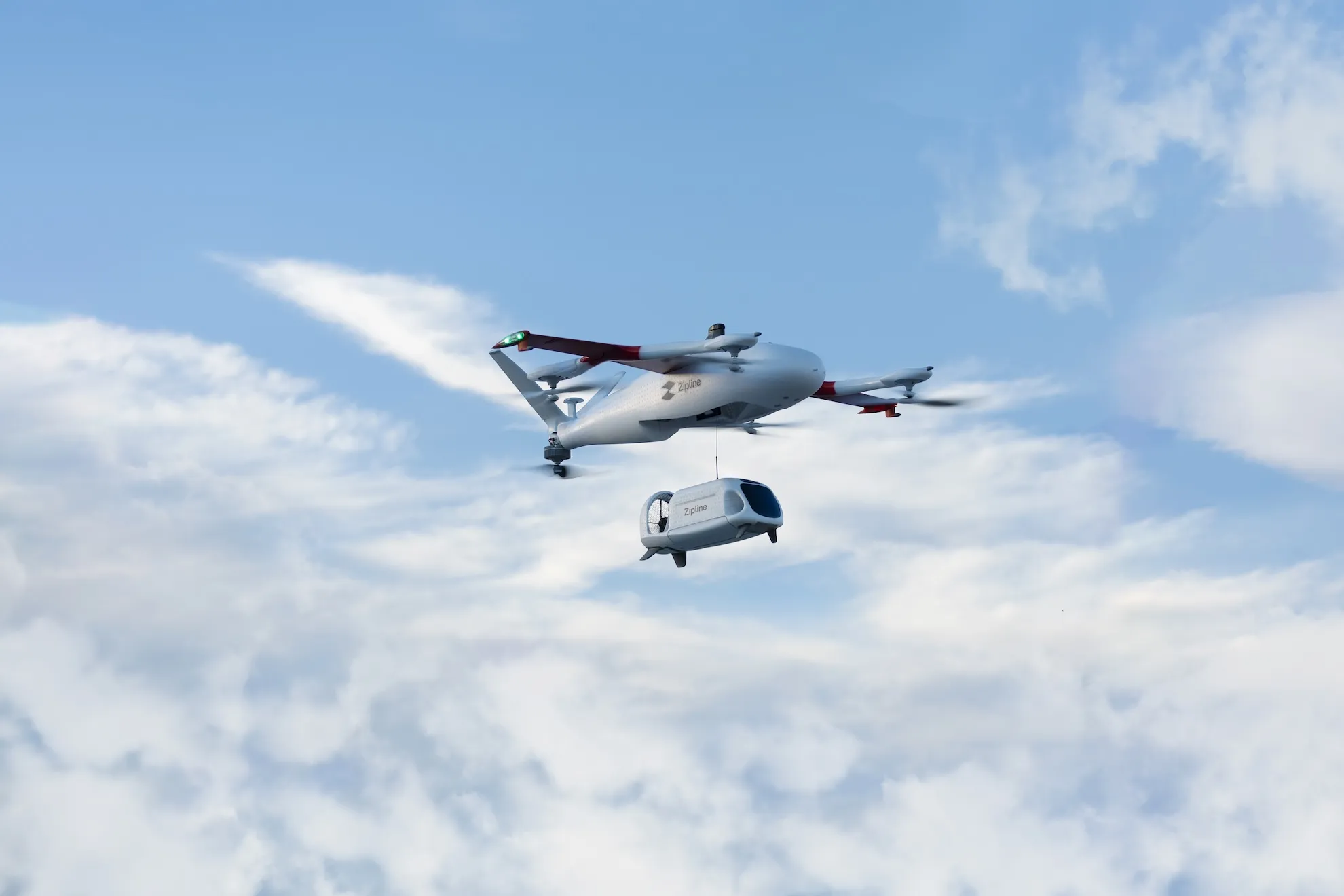
The U.S.-based autonomous drone delivery company has secured an additional $200 million, pushing its latest funding round to a substantial $800 million. The fresh capital builds on a Series H round first unveiled in January, reinforcing investor confidence in a business model that blends logistics, software and cutting-edge aviation.
“Things have moved a little faster than we expected,” said founder and CEO Keller Cliffton in a video update shared on X.
Capital Meets Momentum
The latest tranche drew backing from Paradigm, joining earlier participants including Fidelity Management & Research Company, Baillie Gifford, Valor Equity Partners and Tiger Global. That initial raise valued Zipline at $7.6 billion, placing it firmly among the most closely watched logistics startups.
The scale of funding reflects a broader bet: autonomous delivery is no longer experimental—it’s edging into everyday infrastructure.
From Blood Deliveries to Broad Logistics
Founded in 2014, Zipline began with a focused mission—transporting blood supplies in Rwanda, where reliable logistics can mean the difference between life and death.
That early use case proved both urgency and viability.
Today, the company operates across five African nations, parts of the United States and Japan, delivering:
- Medical supplies
- Food and retail goods
- Agricultural products
Zipline didn’t just build drones—it engineered a full ecosystem. Aircraft, launch systems, landing technology and logistics software work in tandem, giving the company control over the entire delivery chain.
Expansion Gains Speed
The new funding will fast-track expansion across the United States, with at least four states targeted this year. The company has already named Houston, Phoenix and Seattle as upcoming markets.
This push reflects growing demand for rapid, local delivery—particularly in suburban areas where traditional logistics can be slower and more expensive.
Consider how consumer expectations have shifted. Waiting days for a package now feels outdated; same-day delivery is quickly becoming the baseline. Zipline is betting that near-instant aerial delivery will be the next leap.
Home Delivery Surges
The company’s U.S. home delivery service, launched last year, is already outperforming expectations.
“We’re actually expecting to accelerate our growth over the next three months, relative to 2025,” Cliffton said.
Usage patterns reveal a deeper behavioural shift. Customers aren’t treating drone delivery as a novelty—they’re integrating it into daily routines.
“In the last three weeks, we’ve actually seen the average amount of stuff per basket increased by more than 20% with customers ordering all the time from Zipline,” he said.
That spike has prompted a rapid response: Zipline plans to double the number of brands available on its app within 30 days.
Two Platforms, Two Strategies
Zipline’s technology stack hinges on two distinct drone systems:
- Platform 2 (P2): Designed for home delivery, carrying up to eight pounds within a 10-mile radius
- Platform 1 (P1): Built for long-range operations, capable of 120-mile round trips for enterprise and government use
The P2 system is already active in Pea Ridge and the Dallas-Fort Worth Metroplex through partnerships with Walmart and multiple restaurant brands.
This dual-platform approach allows Zipline to serve both everyday consumers and large-scale institutional clients—a rare combination in logistics.
Global Ambitions Remain Central
Despite its U.S. momentum, Zipline continues to deepen its international footprint.
The company recently secured a nationwide agreement in Rwanda to roll out its Platform 2 service across major cities. It is also establishing a third distribution centre aimed at reaching every hospital and health facility in the country.
That expansion underscores a key principle: while drone delivery may feel futuristic in urban America, it already functions as essential infrastructure in parts of Africa.
Zipline’s trajectory raises a broader question for the logistics industry.
If drones can deliver faster, cheaper and more reliably than traditional systems, what happens to the networks built around roads, warehouses and last-mile drivers?
Author: George Nathan Dulnuan