
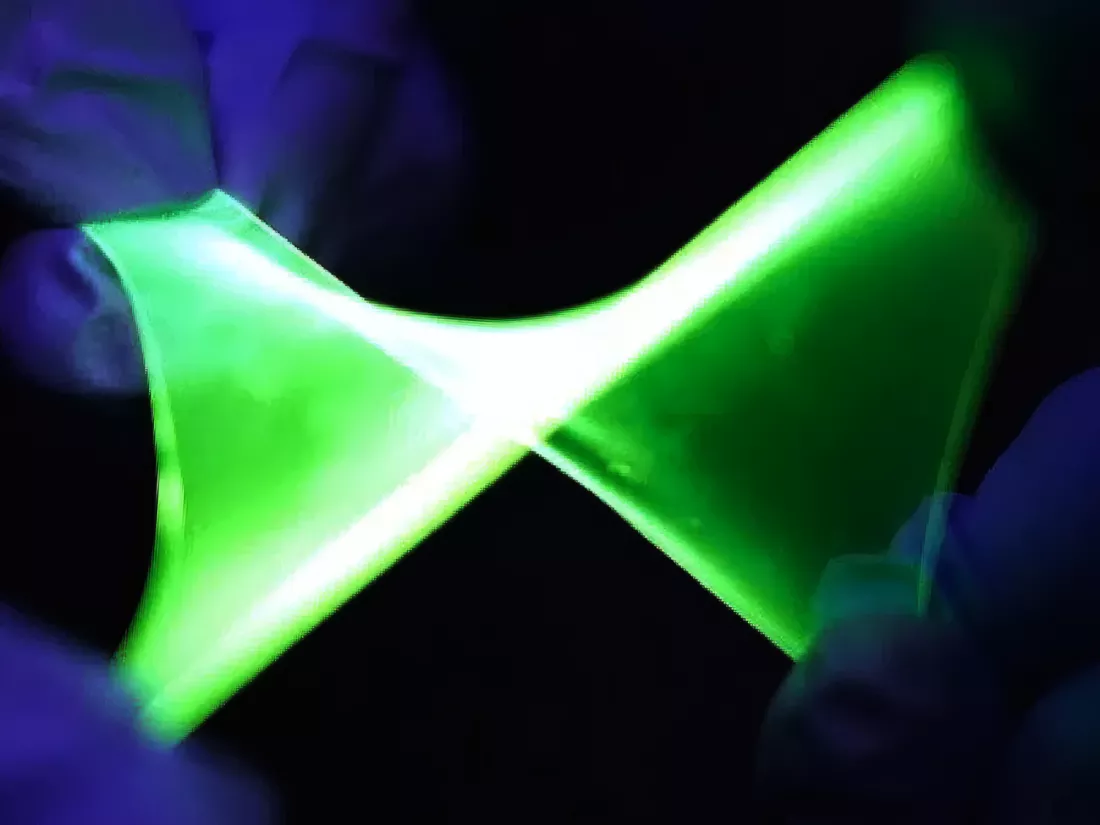
Researchers have moved display technology closer to a long-standing goal: true stretchability without compromising light output. A joint team from Drexel University and Seoul National University has developed a stretchable OLED display that can expand to twice its original size while maintaining consistent brightness and record-setting efficiency.
The advance addresses a challenge familiar to anyone who has seen flexible screens bend, crease, or dim over time. Engineers have been making displays thinner and more flexible for years, but stretching them without performance loss has remained elusive. This new OLED design suggests that compromise may no longer be necessary.
At the heart of the breakthrough is a material known as MXene. These ultrathin, highly conductive sheets behave differently from conventional metals. Rather than cracking under stress, their layered structure allows them to bend and slide internally. The material combines the electrical performance of metals with the mechanical adaptability of polymers.
MXenes were co-discovered by Drexel materials scientist Yury Gogotsi and consist of layered carbides and nitrides. When researchers used them as transparent electrodes in OLEDs, the results surpassed the industry standard, indium tin oxide, on two crucial fronts: elasticity and brightness.
OLEDs operate by stacking conductive and organic layers that emit light when electrical charges meet. For decades, manufacturers have relied on indium tin oxide as the transparent anode in this structure. The material performs well on flat, rigid surfaces, but it fractures under strain. That brittleness has limited OLEDs in applications that require stretching or repeated motion.
MXenes remove that limitation. The team produced films just 10 nanometres thick that maintained electrical conductivity even as the display stretched to double its original size. Instead of dimming or failing, the OLED continued to emit light evenly.
Efficiency gains were equally notable. The display achieved an external quantum efficiency of 17 per cent, meaning a high proportion of electrical energy converted directly into visible light. Experts describe this as a record for intrinsically stretchable OLEDs.
Materials scientist Seunghyup Yoo of KAIST highlighted that 20 per cent efficiency is widely regarded as a theoretical ceiling, placing this result close to the limits of physics.
The performance did not rely on the electrode alone. The Seoul-based researchers redesigned the OLED’s internal architecture, adding two organic layers. One channels positive charges more efficiently towards the light-emitting region, while the other captures energy that would normally dissipate as heat and redirects it into light production. Together with the MXene electrode, these layers preserved brightness and stability even as the display deformed.
The implications extend well beyond smartphones. Stretchable, high-efficiency OLEDs could transform industrial interfaces, soft robotics, and wearable technology. Gogotsi sees particular potential in medical and diagnostic devices that could display vital signs in real time, offering richer data than today’s smartwatches or fitness trackers.
Before commercialisation, however, key obstacles remain. Yoo and University of Chicago researcher Sihong Wang, both specialists in stretchable electronics, note that encapsulation is a major challenge. OLEDs degrade quickly when exposed to oxygen and moisture, and most existing barrier layers rely on rigid materials. Engineers will need flexible, durable encapsulation solutions that protect the display without restricting movement. Long-term image uniformity under repeated stretching also requires validation.
Even with these challenges, the researchers see this work as a clear inflection point. Gogotsi anticipates that displays will move steadily away from rigid devices and towards seamless integration into everyday objects.
Author: George Nathan Dulnuan