
Published: Jan. 24, 2026
Category: Tech · Services & Software · AI · Entertainment
A warm breeze cuts through the carefully groomed walkways at Walt Disney Studios in Burbank as sunlight catches the iconic Team Disney building. Massive stone figures of the seven dwarfs hold the structure aloft a deliberate reminder of the hand-drawn artistry that launched the company nearly a century ago.
Just steps away, inside Disney’s Main Street Cinema, executives and engineers are grappling with a very modern question: how to accelerate animation without hollowing out the creative soul that built the brand.
Four startups stand before a room of Disney leaders and journalists, pitching technologies designed to shape the next era of storytelling. One company stands out. Animaj, a Paris-based animation studio and AI platform, demonstrates how artificial intelligence can dramatically speed up animation production while keeping artists firmly in control.
On the screen, brightly colored characters from the children’s series Pocoyo leap and spin with fluid motion. What once required months of painstaking frame-by-frame work now materializes in seconds.
“Thanks to this tool, it takes less than five weeks to produce a 5-minute-long episode, whereas it used to take five months,” Animaj CEO and co-founder Sixte de Vauplane says.
Acceleration without replacement
The speed comes from advances in generative AI that have reshaped creative tools over the past few years. By 2025, video-generation platforms such as Google’s Veo 3 and OpenAI’s Sora 2 had brought AI animation to the masses, allowing anyone to produce animated clips from a phone with no drawing skills required.
Hollywood has responded cautiously. Unions and artists worry that automation could erode jobs built on years of craft. Animaj positions itself differently.
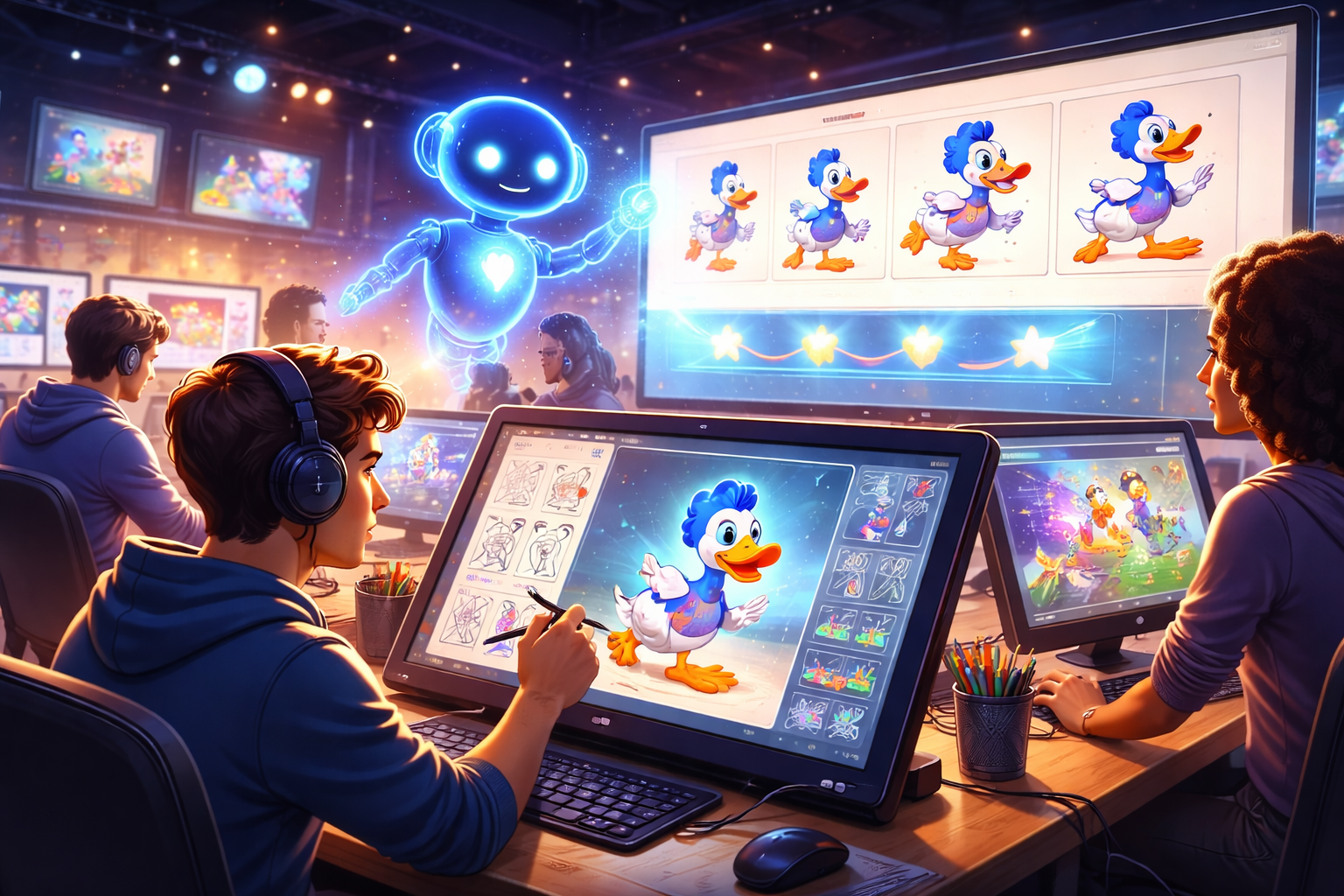
Its system does not replace animators. Artists still sketch every major pose. AI handles the repetitive work generating the in-between frames that carry a character from one pose to the next. Animators review, correct, and refine every movement.
“The artist is in control. For us, it’s super important because we know that AI can be seen as a threat for the artist,” de Vauplane says. “We want to show that there is another way to use AI in a very ethical way.”
That distinction matters at Disney, where hundreds of animators work across television and film. The company confirms it plans to formalize its partnership with Animaj, with discussions underway about deploying the system across Disney Branded Television and Disney Television Studios.
“The plan is to announce something in the coming months,” says David Min, vice president of Disney Innovation.
Why Disney chose Animaj
Disney’s decision followed an exhaustive search. Min says the company evaluated “pretty much all of the AI companies” before selecting Animaj.
“We looked at thousands of companies, all big and small, and what Animaj does well is that the artist is really driving the process,” he says. Unlike text-prompt video generators that often produce inconsistent or unusable results, Animaj’s system begins with human-drawn keyframes and fills in only what the artist allows.
“This is the artist drawing the key frames from A to Z, and then allowing things to be filled in in between. That’s why we selected Animaj,” Min adds.
The choice reflects a broader reality in entertainment. Streaming platforms demand constant output. Audiences move on quickly. Animation pipelines built for theatrical timelines struggle to keep pace.
“It can be like a year before you can even get a pilot of something to test out,” Min says. “With Animaj, they can do it in 30% of the time.”
From hand sketches to instant motion
Animaj’s technology rests on an enormous data foundation. The company trained its AI on more than 300,000 character poses drawn from four seasons of Pocoyo, pairing hand-drawn sketches with their corresponding 3D models. Artists then produced additional sketches to expand the dataset for future seasons.
The process works like this:
• An animator sketches key character positions, such as standing and sitting
• The AI predicts the in-between motions, a process Animaj calls “motion in-betweening”
• The animator reviews and adjusts every generated movement in real time
Antoine Lhermitte, Animaj’s chief technology officer, watches an animator refine arm and leg movements with a stylus, correcting the AI where it strays. The payoff is time hours, weeks, sometimes months reclaimed from repetitive work.
That time shifts animators away from mechanical labor and back toward storytelling, pacing, and visual style. It also allows Disney and its partners to test ideas faster, respond to audience trends in near real time, and iterate before momentum fades.
For Disney, the equation is clear. AI succeeds only if it amplifies human creativity rather than displacing it. The seven dwarfs outside still stand guard, symbols of a craft built by human hands. Inside, the tools have changed, but the goal has not: tell better stories, faster, without losing the people who know how to make them matter.
Author.Adigun Adedoye.